Showing posts with label dinosaurs. Show all posts

Friday, 25 March 2016

Standing in the footsteps of Dinosaurs

Most wildlife enthusiasts visit the Isle of Wight to see Red Squirrels (as this blog did back in 2011: http://viewsoftheock.blogspot.co.uk/2011/03/tale-of-two-squirrels.html) an animal that is almost extinct in most parts of the UK.
But in autumn last year we visited with the intention of finding signs of an animal that became extinct 120 million years ago - dinosaurs.
Back then the Isle of Wight was part of a large river complex  of rivers, swamps and ponds that stretched from the south of England through northern Europe, where over 20 species of dinosaur lived, mated and died and over time the swamps turned to rocks and the rocks became cliffs and the dinosaur bones turned to stone. Like this iguanodon  foot sited in the Dinosaur Isle museum:
.
.
But it's not only bones that become fossilised, buy on occasion the dinosaur's footprints do as well, like these at Hanover Point on the island's south coast.

.
The three toed footprint matching the remains of the iguanodon which was found nearby.
.
.
The footprints fossils were formed by the imprint of the dinosaur foot being filled with mud and sediment, this gradually tuned to white rock sandstone and formed the distinctive cast while the rest of the stone was eroded.
Although some aren't as obvious as others:


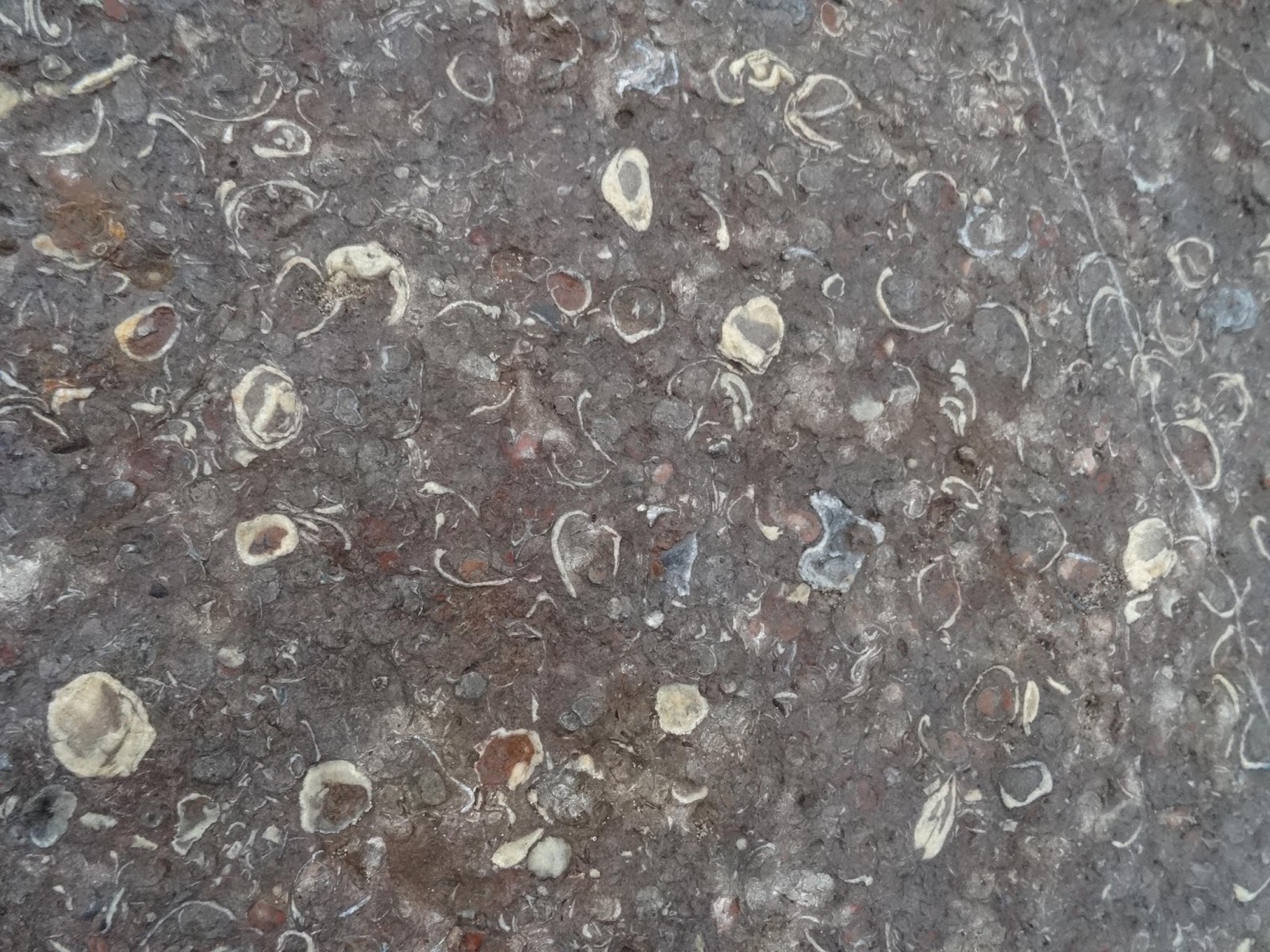
It's not just dinosaurs that have left their mark on the beeches of the Isle of Wight, there are countless fossilised shells:
.
.
And even fossilised wood, from the time when the area was covered in forests - perhaps even browsed upon by the same animals which left these footprints.
.

Saturday, 16 May 2015

Sophie the Stegosaurus

The Natural History Museum in London is famous for it's dinosaurs, yet it's most iconic, Dippy the Diplodocus in the entrance hall is actually one of ten plaster casts of a dinosaur in Pennsylvania and it now has a rival - Sophie the stegosaurus


Named after the daughter of the benefactor who helped pay for it, this young dinosaur (whose gender is actually unknown) is 85% complete is the most complete stegosaurs yet found.


And it makes a mesmerising display in the Earth Hall when entering via Exhibition Road.


.
Sophie is a Stegasarus stenops and belongs to the group of dinosaurs known as the stegosaurs which are defined by their heavy body armour and defensive tail spines.
.
.
Sophie isn't the only stegosaur at the Natural History Museum, located across from the vast display of itchyosaurs are the fossilised remains of a Dacentrurus armatus:
.
.
Whilst not as impressive as Sophie - consisting of only a pelvis, vertebrates, femur and the defining tail spine -  it is the first ever stegosaur to be described and whilst Sophie was found in Wyoming in 2003, this one found in Swindon in 1875.

Reference:
Dinosaurs of the British Isles by Dean Lomax: http://www.deanrlomax.co.uk/Books.html

Tuesday, 18 February 2014

Return to the Oxford University Museum of Natural History

After 14 months the University of Oxford Museum of Natural History has reopened it's doors.  During that time the splendid gothic roof has been repaired and for the first time since it was opened in 1860 it has not leaked.
.
.
As always the cast of the Tyrannosaurus Rex makes an impressive centre piece.
.
.
It takes something special to outclass a dinosaur and on the opening Saturday it was by the opportunity handle some live exhibits, including this Pervian bird eating spider:
 .
.
But even this was outclassed by a remarkable Leaf Insect:
.
.
Now it has reopened, there will be many opportunities to enjoy the museum, including an new exhibition on Wytham Woods and what looks like a rearranged Dinosaur collection.
And as there is now a cafe in the top gallery there is no need to leave to get a cup of tea and cake.

The museum now has a twitter account: https://twitter.com/morethanadodo

And a new blog: http://morethanadodo.com/

Sunday, 7 October 2012

University of Oxford Natural History Museum


For the enthusiast of the natural world, there are many reasons to enjoy living near to the city of Oxford – Wytham Woods to the west, Harcourt Arboretum to the south and the Botanic Gardens in the city centre are splendid places to spend a sunny and warm day.
But as the days start to get shorter and the weather starts to get colder a turn, the best place to head is the Oxford University Museum of Natural History:
.
.
Built in 1859, the fantastic neo-gothic building houses the Oxford University’s collection of zoology, entomology and geology and  is the casts of the Tyrannosaurus and Iguanodon that first grasp your attention as you walk through the entrance:
.
.
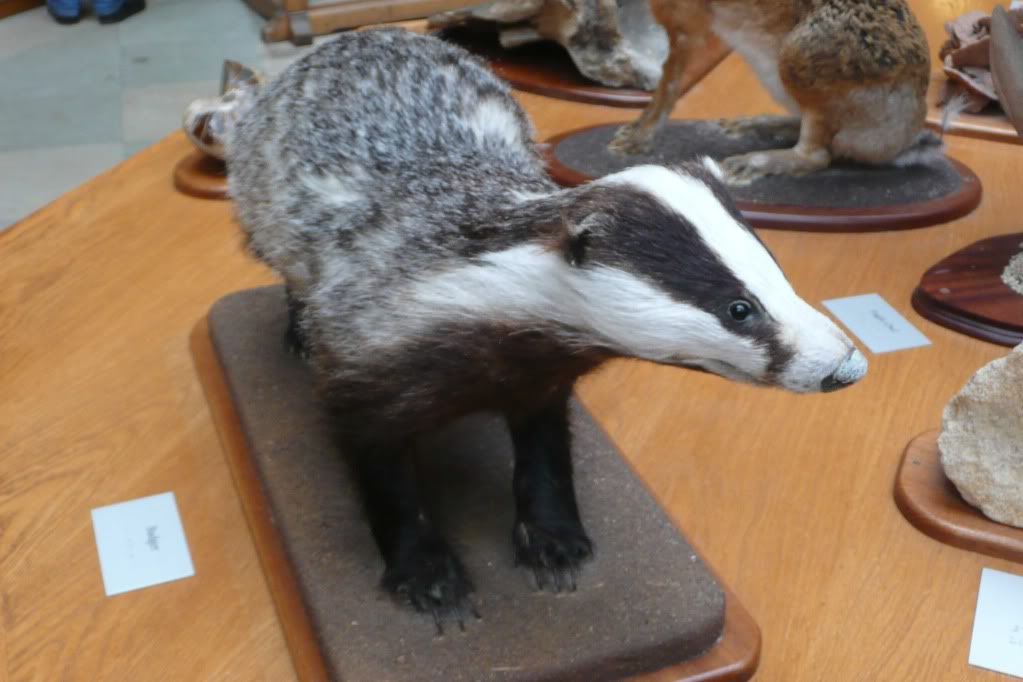
The exhibits of local geology & palaeontology are fascinating and even the ones local wildlife are interesting, even if it is somewhat sad to see animals that have featured in this blog as stuffed exhibits in a museum (even one as good as this):
.
.
.
.
Although it is the entomological exhibits that are probably the most engrossing - especially the displays of living insects, perhaps none more than the honey bees, which can be seen bringing pollen from outside the museum to their specially constructed glass walled hive and then doing their waggle dance to explain the location of nearby flowers.
.

It is best  to make the most of the Museum this year, as it closes throughout 2013 for the splendid (but leaking) gothic roof to be repaired (although access to the Pitt Rivers museum remains open):