Showing posts with label bumblebee. Show all posts

Thursday, 24 July 2014

Bee identification

I received the following comment from Becky in a previous post.

Hi. Could you recomend a book or website to get me started on identifying bees. I have lots of visitors to my garden, but not sure what they are. Many thanks. Becky

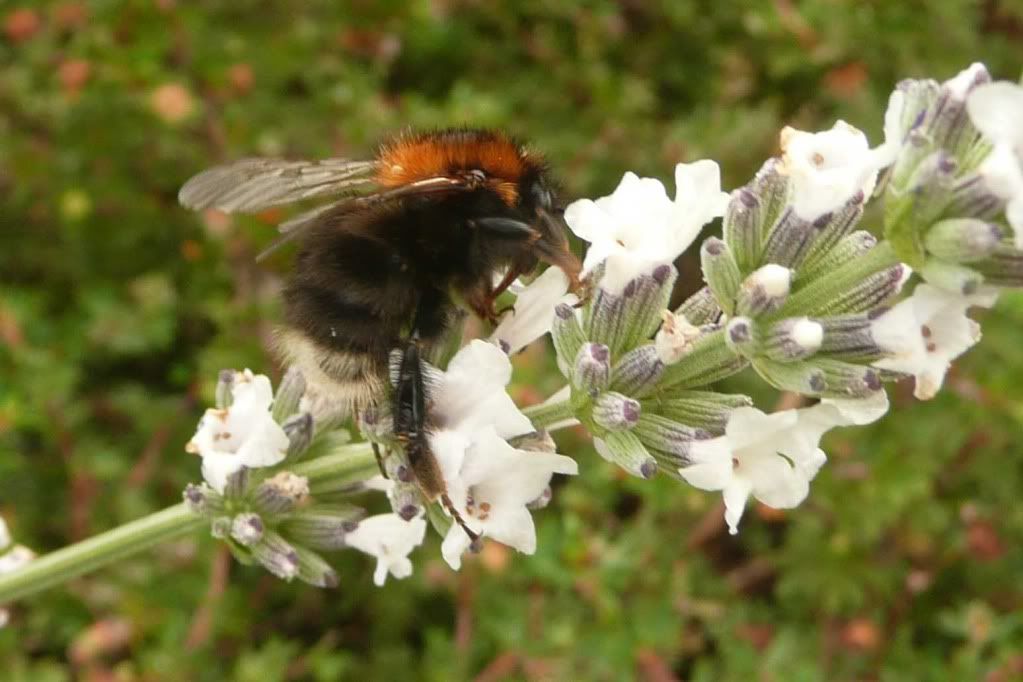
Whilst some bees are easy to identify - such as the tree bumblebee, with it's brown thorax and white tipped abdomen:
.
.
However, most of the times it is  fraught with difficulties - males and females  of the same species often look completely different and even older worker bees can look different to their younger sisters.

I am not an expert in bee identification, but I though the subject warranted a post in it's own right.

Bumblebes
For bumblebees, the first point of call is this excellent identification chart from the Bumblebee Conservation Trust, it has large, clear pictures with text  and showing queens, workers and is available on-line as a PDF: http://bumblebeeconservation.org/images/uploads/Resources/BBCT_Bumblebee_ID_sheet_(big_8).pdf


(C) Bumblebee Conservation Trust

A more detailed guide is The Field Guide to Bumblebees of Great Britain and Ireland by Martin Edwards and Martin Jenner: 

http://www.waterstones.com/waterstonesweb/products/michael+chinery/british+insects/6440438/

It contains a very good identification guide where different abdomens and thorax can be matched together.
It's main drawback is that it doesn't use common names, so whilst it can be used to identify Bombus Terrestris, it takes an internet search to find out it is a buff tailed bumblebee.

Solitary Bees Whilst bumblebee identification is hard enough, trying to identify the any of the 200 solitary bees found in the UK is even harder.

The most common are found in the informative Collins guide to British Insects:


http://www.amazon.com/Complete-British-Guides-Collins-Photographic/dp/0007298994/ref=sr_1_3?ie=UTF8&qid=1403810338&sr=8-3&keywords=collins+guide+to+insects

Another source of information is the the excellent Guide to Garden Wildlife, by the local artist Richard Lewington (http://www.richardlewington.co.uk/) which features drawings rather than photographs, making identification somewhat easier.


http://www.britishwildlife.com/viewbook.asp?bookid=2


Internet:

The internet is a great source of identification and the forums on Wild About Britain (http://www.wildaboutbritain.co.uk/forums/) are always a friendly place to ask for identification.

And the bumblebee conservation trust has launched Bee Watch: http://homepages.abdn.ac.uk/wpn003/beewatch/index.php?r=user/auth

Apps:

Apps are now replacing books on as field guides and the art work of Richard Lewington can be found on Nature Guides Bumblebees of Britain and Ireland, as of yet, it is only available on iOS:

https://itunes.apple.com/gb/app/bumblebees-britain-ireland/id657077156?mt=8


Hopefully Becky, you've found this useful

Wednesday, 13 July 2011

The perils of bumblebee mating

As featured in a previous post, now summer is here, male and queen bumblebees are now on the wing. 
As the bumblebee nest reaches the end of its life queens and males are produced.  The males hatch from unfertilized eggs usually laid by the queen, but sometimes worker bees will produce eggs that will turn into males (if the queen has died or if it is a large nest). The males fly around in what is called a circuit, using scent drops to attempt to attract a queen.
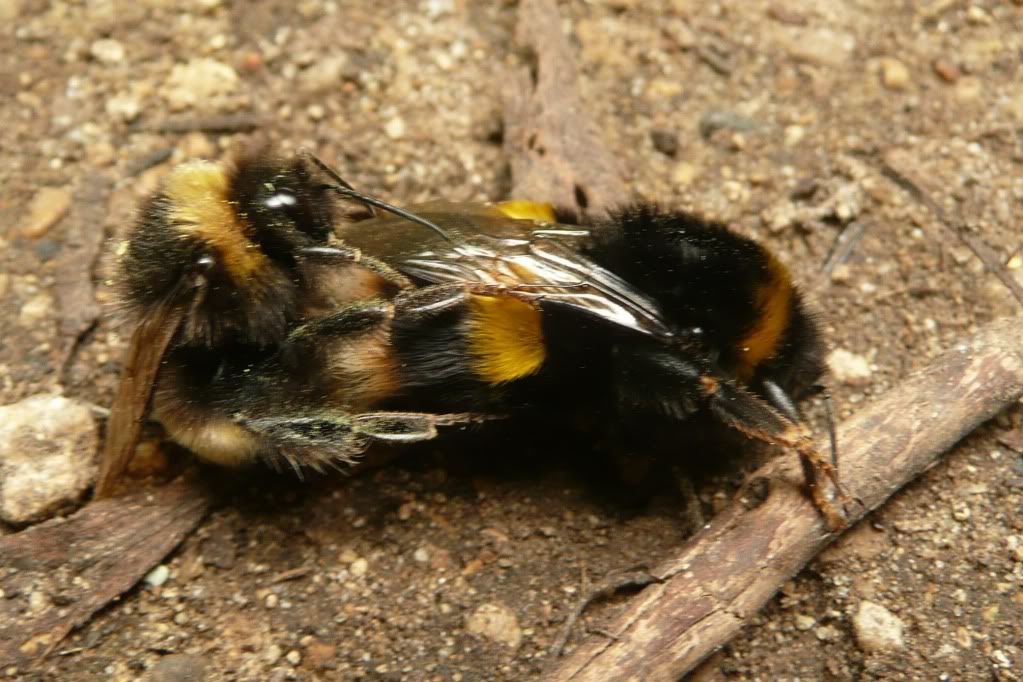
Although individual males and queens are often seen separately, it is unusual to see them in the act of mating. These two were seen along the cycle path to Oxford, near Radley Lakes:
.
.
At first glance they could be red tailed bumblebees (Bombus Lapidarius), but the dark wings on the female and the lack of yellow stripe on the thorax off the male mean they are more likely to be the cuckoo variety (Bombus rupestris):
.
.
For most animals, the act of mating is often short - during this time they are open to predation, they are not feeding and they could be seeking out another mate. But for bumblebees it is an arduous activity (certainly for the queen) and may last for 45 minutes. After mating the male injects the female with 'bung' preventing her from mating (a chemical chastity belt) and it will be the last time she mates. Unlike male honey bees (which die after mating), male bumblebees are free to mate again.
As the queen is weighed down by a male (and sometimes two) she is unable to fly, which can put them in harm's way, like these buff-tailed bumblebees (Bombus terrestris) seen on the footpath along the Ock Valley Walk:
.
.
They were then moved aside to prevent them being crushed (seemingly unfazed about being picked up by a stick and a leaf):
.
.
Unfortunately a different fate awaited this pair along Mill Road, near the Ock, which seem to have spent so long mating that they were not aware of an on coming car:
.
.
References:
Field Guide to Bumblebees  of Great Britain & Ireland: Mike Edwards & Martin Jenner
Bumblebees: Christopher O'Toole
Wild About Britain

Monday, 4 July 2011

Tree Bumblebees

Since 1960 there has been a decline of 60% in the population in the 25 species of UK bumblebees. A contributory source is possibly the 90% loss of habitat since 1930's (source Bumblebee Conservation Trust). 
Despite this, there is one bumblebee species that has an increasing population - the tree bumblebee (Bombus hypnorum).
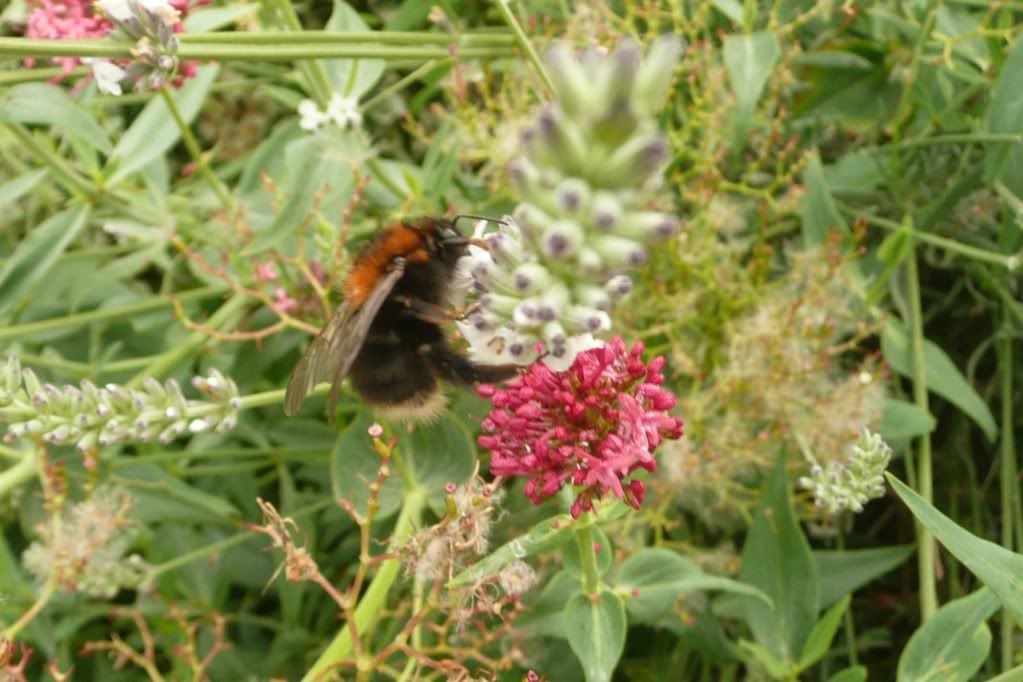
Having arrived from Europe, it was first discovered in the UK in 2001 in the New Forest  and has been spreading north ever since.  Even so, it is a pleasure to find a female worker in our garden, feeding with the other bees on the always popular lavender:
.
.
Unlike most bumblebees they are easy to identify - with a distinctive brown thorax, black abdomen and white tail:
.
.
Whilst most bumblebees nest at ground level (preferring old mammal burrows), tree bumblebees prefer to nest above ground, finding bird nest boxes the ideal location - perhaps explaining part of it's success.
The Bumblebee Conservation Trust is recording sightings to see how tree bumblebees are spreading throughout the UK in an on-line survey: http://www.bumblebeeconservation.org.uk/tree_bee.htm

Sunday, 26 June 2011

Weekend Bumblebees

The hot weather this weekend has been an ideal opportunity to look for bumblebees and the wild flowers that grow alongside the river are perfect location.
Trying to identify bumblebees can be difficult as not only do several species have the same colour, but the same species can have different colours - so clarifications and corrections are most welcome.
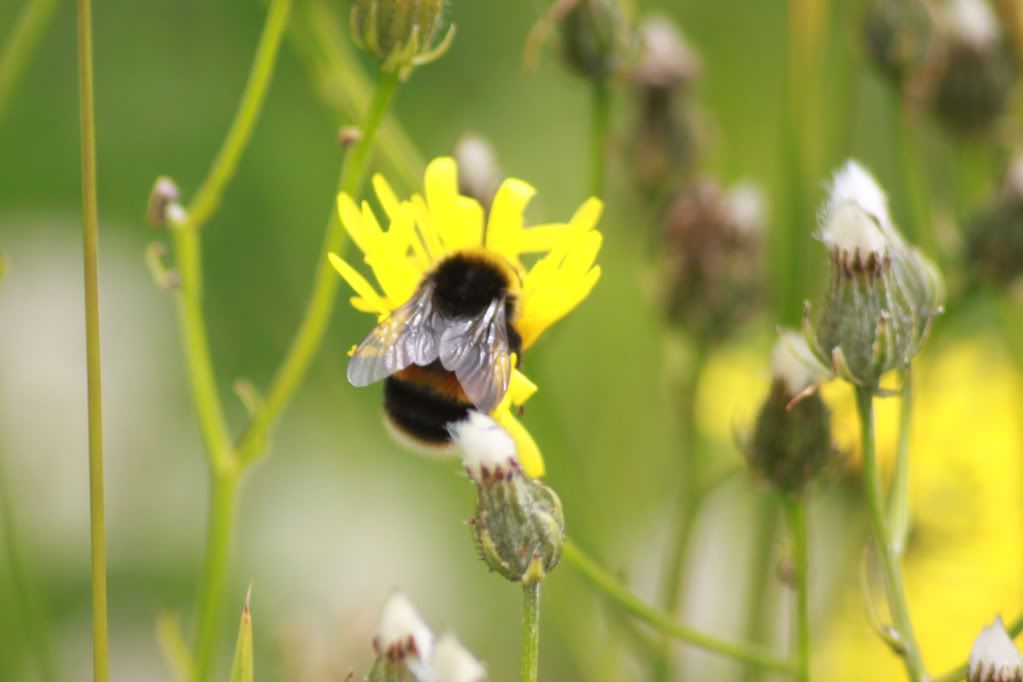
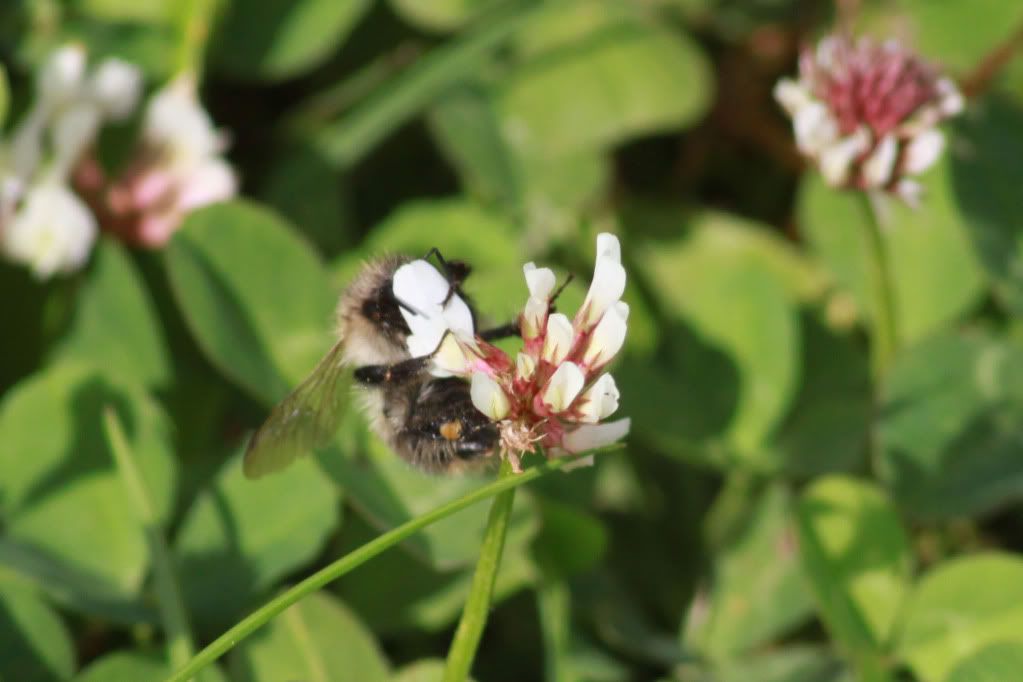
This one is a female worker, probably a white tailed bumblebee (Bombus lucorum) -although garden bumblebees look very similar.
.
.
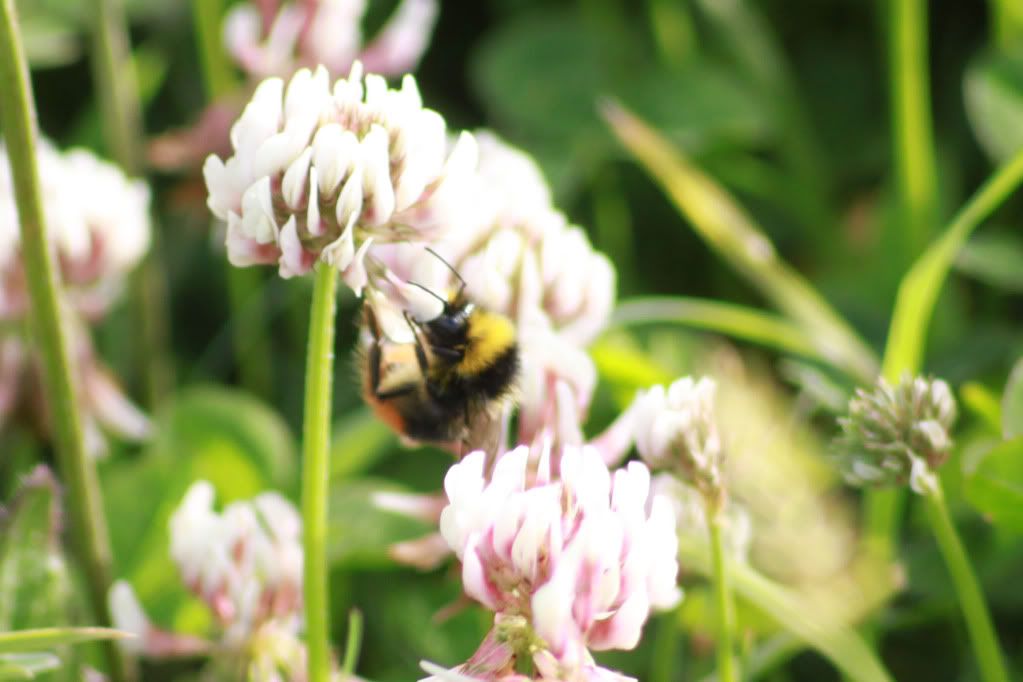
Although a nunesance in a lot of lawns, the flowering clover is particular attractive to bumblebees especially this female common carder bee (Bombus pascuorum):
.
.
With it's black body and red tail, this female worker is probably a red tailed bumblebee (Bombus lapidarius):
.
.
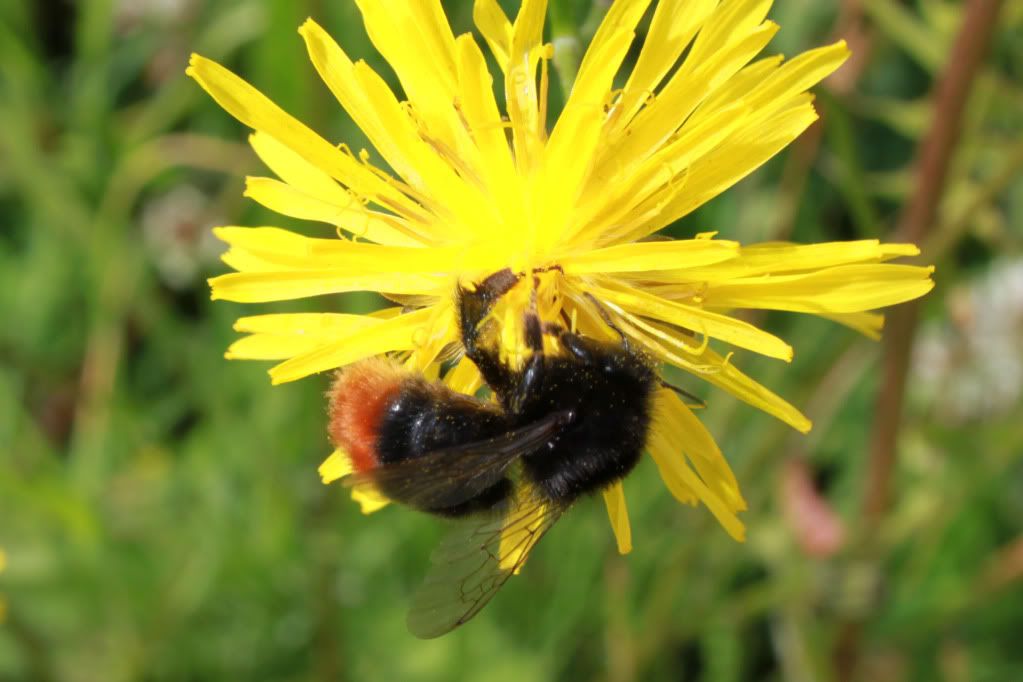
Although this bee has different colours, it is probably the same species as the red tailed above, but this is a male.
.
.
This bumblebee is probably a queen, as it is a lot larger than the males and workers.  The red tail would suggest that it is also a red tailed bumblebee.  But the dark wings could indicate that it is actually a cuckoo bumblebee (Bombus rupestris):
.

Wednesday, 28 April 2010

Cuckoo Bumblebee

Spring is the time of year when queen bumblebees emerge from hibernation, seek suitable nest sites and start a colony. Such as this buff tailed bumblebee I saw earlier in the year.


The colony then produces female worker bees, males and next years queens. Before it descends into chaos and eventually collapses towards the the end of the year.
There are may threats to bumblebees including parasitic wasps, mites and badgers. But one threat comes from another type of bumblebee - the cuckoo.  There are six types of cuckoo bumblebee in the UK and this one, seen on the dandelions in the ock meadow, is a southern cuckoo bee:


As can be seen from it's markings, it looks very similar to the buff tailed bumblebee (on whose nests it mainly attacks), the main difference is the lack of a yellow band on it's abdomen and the thin yellow lines above the white tail:


Like its avian namesake, the cuckoo bumblebee takes advantage of the nests of others.  It wakes later in the year and feeds off flowers whilst it finds a nest to parasitize.  When it finds a nest the queen will hide herself inside, absorbing the smell. When this is complete, she will find and sting to death the existing queen, replacing her and subjugating the workers.
The new queen lays her own eggs, but these will only turn into males and queens who are attended to by worker bees from the deceased queen.


But life for a cuckoo bumblebee can be dangerous. If she selects a nest that is too established it's workers will attack and her.  Apparently it's not uncommon to find several cuckoo bee corpses outside a nest.
As Martin says below 'nature can be harsh'.


Thanks to Natasha Rolph of the Bumblebee Conservation Trust for taking the time to answer my questions.

Monday, 25 May 2009

Bumblebee mating?

I witnessed these three buff tailed bumblebees this morning on my back lawn.


Initially I thought they were mating - which is apparently seldom seen, with the large bee being a queen and the two smaller ones males. But as they're still there (30 minutes after this picture was taken) it could be two female worker bees attacking a queen which hasn't yet nested.

I've contacted the bumblebee conservation trust and posted on the wild about britain forum and will update this post if I get any replies.

Update: After writing this post, posting on the forum and sending emails the bees have now gone, maybe they've finished or the local sparrows have eaten them.

Update #2: Just had this reply from the Outreach Officer at the Bumblebee conservation trust:

The larger bumblebee, the queen is mating with one of the males. The other little male is hanging around and hoping to get involved with queen too! This photo is a brilliant example of the mating culture of bumblebees.

There is also the possibility of the picture being used in the trust's news letter.

Although it may appear to be too early for bees to be mating, it could well be an 'early bumblebee', which are short lived colonies, producing males in April and are often seldom seen after July. So a lucky find.

For more bumblebee mating photographs please see: 
http://viewsoftheock.blogspot.com/2011/07/perils-of-bumblebee-mating.html


Reference:
Bumblebee conservation trust: http://www.bumblebeeconservation.org/bumblebees_id.htm


Sunday, 5 April 2009

Bumblebee

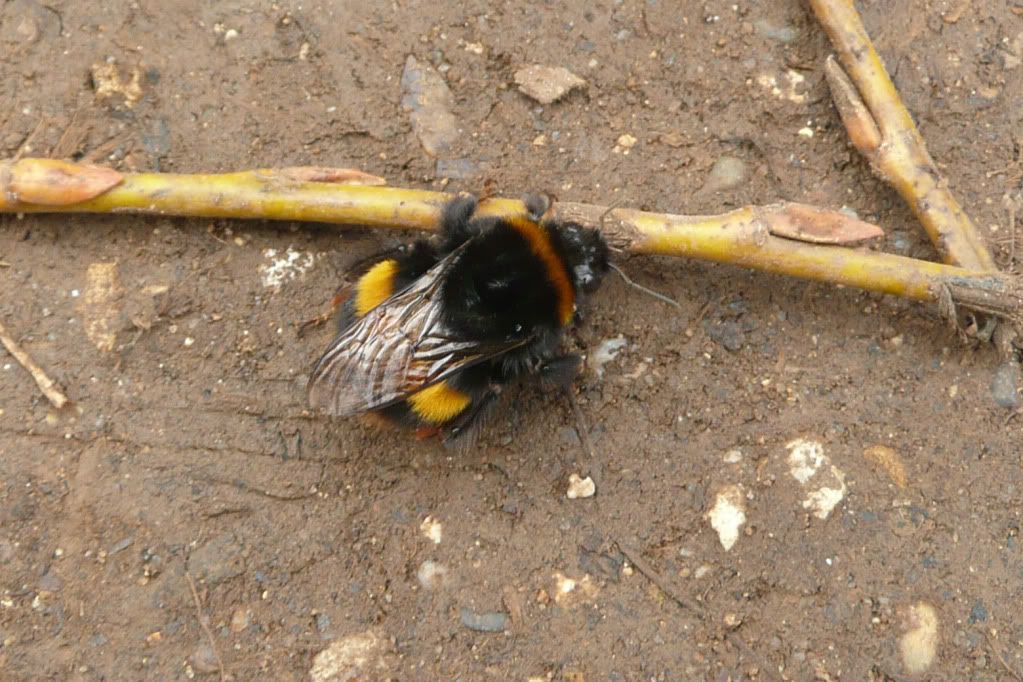
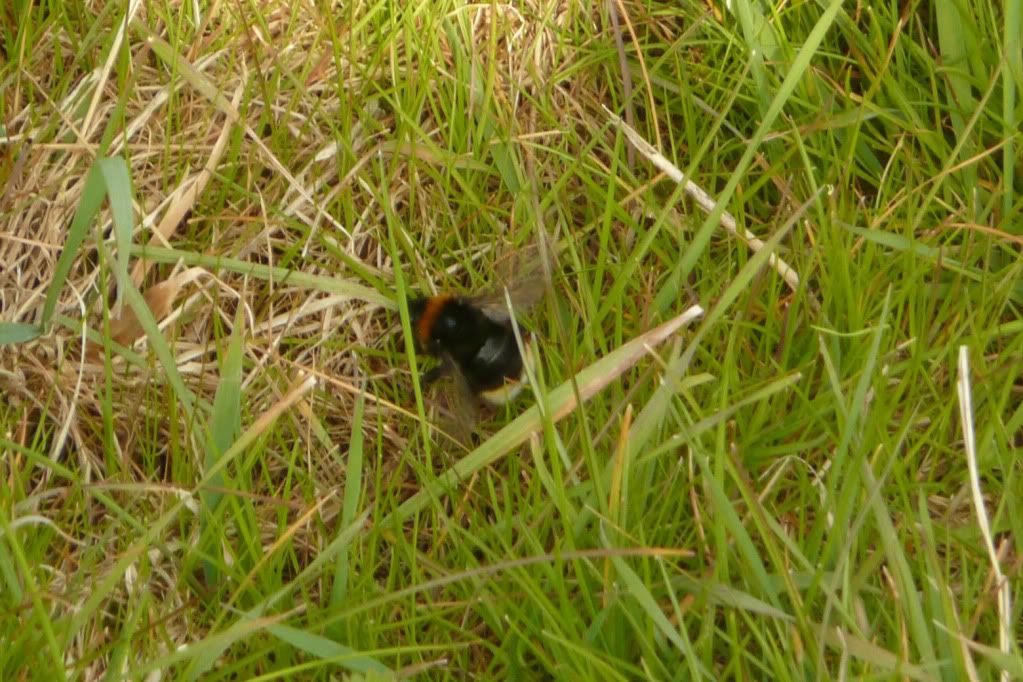
Spring is the time when hibernating bumblebees seek out nest sites. This Buff-tailed bumblebee was searching for a nest near the Ock:


Further information on Bumblebees can be found at the bumblebee conservation trusts web site at:

http://www.bumblebeeconservationtrust.co.uk/bumblebees_id.htm

And the news on their 2009 bee survey at:

http://www.bumblebeeconservationtrust.co.uk/beewatch.htm