Wednesday, 15 October 2014

The stags of Richmond Park

Some of the great sights of autumn - a murmation of starlings and the fungus in a English woodland can be see in Oxfordshire.
Yet what is perhaps  the most impressive, the rut of the Red Deer, can be found close to London at Richmond Park
.
Established in 1625 by Charles I for hunting fallow and red deer, Richmond Park is 12 miles from London and covers an area of four square miles.  
It is still home to royalty,  Princess Alexandra still lives there, but thanks to careful management has become London's largest SSSI, a National Nature Reserve and Special Area of Conservation. It is one of the most important sites in the UK for ancient trees and is home to rare animals like the cardinal click beetle, the stag beetle and  the lesser spotted woodpecker.
But it is the deer that are by far the most obvious and what makes the park famous - especially in autumn, when the stags are at their most impressive:
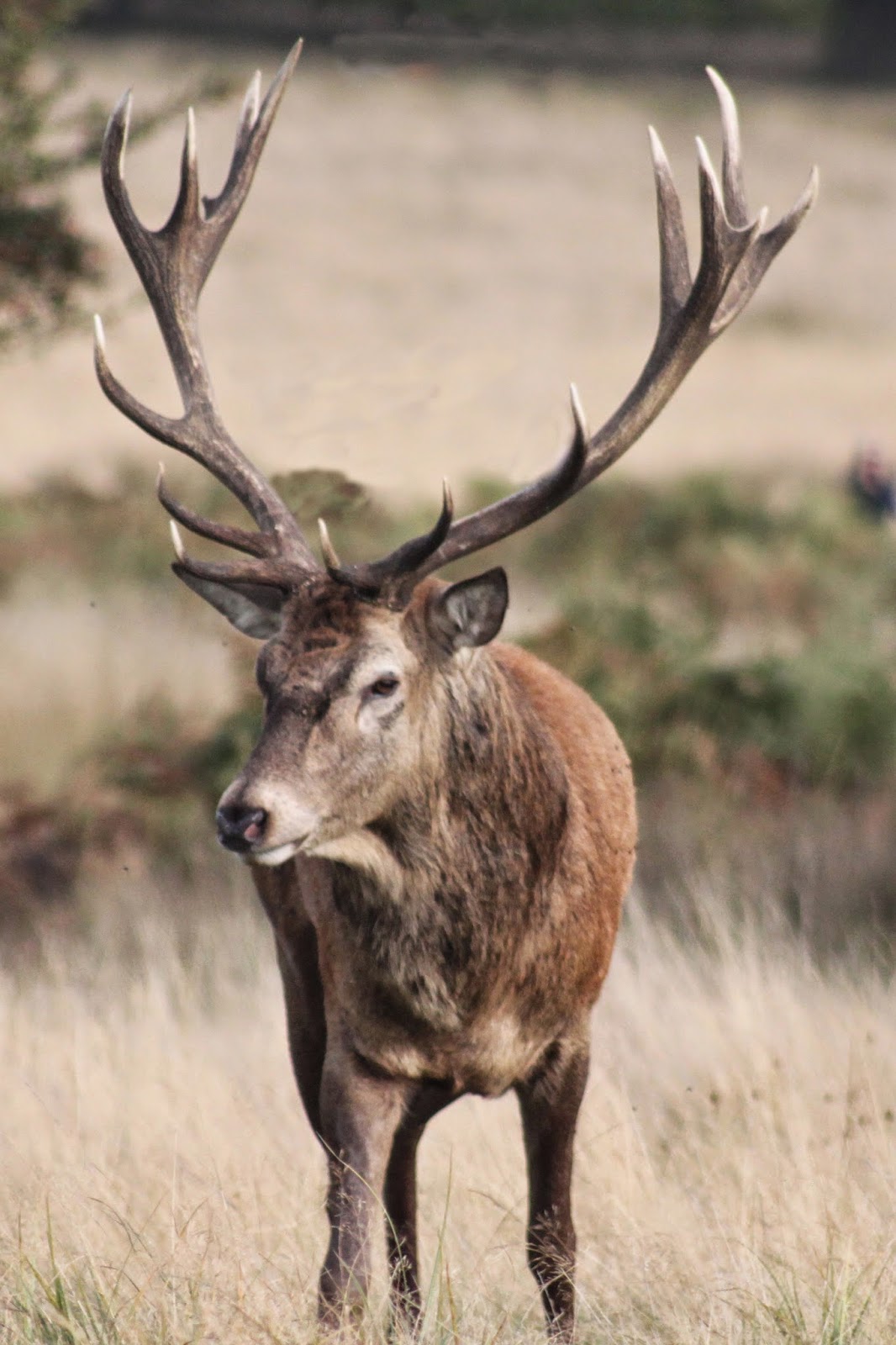

.
During the day the stags are not too active, often keeping an eye on their hinds (female deer) or just having a rest


With an occasional bout of bellowing to warn off other stags who might be encroaching into their territory. 
.
.
But as the day light starts to fade and just before the park closes for the night, the stags become more active, chasing off rivals, often with bracken on their antlers - as if to make themselves even more intimidating. 
.
.
If that doesn't work then the final resort is combat - an impressive struggle between two members of what is Britain's largest native land mammal.
.
.

Thursday, 24 July 2014

Bee identification

I received the following comment from Becky in a previous post.

Hi. Could you recomend a book or website to get me started on identifying bees. I have lots of visitors to my garden, but not sure what they are. Many thanks. Becky

Whilst some bees are easy to identify - such as the tree bumblebee, with it's brown thorax and white tipped abdomen:
.
.
However, most of the times it is  fraught with difficulties - males and females  of the same species often look completely different and even older worker bees can look different to their younger sisters.

I am not an expert in bee identification, but I though the subject warranted a post in it's own right.

Bumblebes
For bumblebees, the first point of call is this excellent identification chart from the Bumblebee Conservation Trust, it has large, clear pictures with text  and showing queens, workers and is available on-line as a PDF: http://bumblebeeconservation.org/images/uploads/Resources/BBCT_Bumblebee_ID_sheet_(big_8).pdf


(C) Bumblebee Conservation Trust

A more detailed guide is The Field Guide to Bumblebees of Great Britain and Ireland by Martin Edwards and Martin Jenner: 

http://www.waterstones.com/waterstonesweb/products/michael+chinery/british+insects/6440438/

It contains a very good identification guide where different abdomens and thorax can be matched together.
It's main drawback is that it doesn't use common names, so whilst it can be used to identify Bombus Terrestris, it takes an internet search to find out it is a buff tailed bumblebee.

Solitary Bees Whilst bumblebee identification is hard enough, trying to identify the any of the 200 solitary bees found in the UK is even harder.

The most common are found in the informative Collins guide to British Insects:


http://www.amazon.com/Complete-British-Guides-Collins-Photographic/dp/0007298994/ref=sr_1_3?ie=UTF8&qid=1403810338&sr=8-3&keywords=collins+guide+to+insects

Another source of information is the the excellent Guide to Garden Wildlife, by the local artist Richard Lewington (http://www.richardlewington.co.uk/) which features drawings rather than photographs, making identification somewhat easier.


http://www.britishwildlife.com/viewbook.asp?bookid=2


Internet:

The internet is a great source of identification and the forums on Wild About Britain (http://www.wildaboutbritain.co.uk/forums/) are always a friendly place to ask for identification.

And the bumblebee conservation trust has launched Bee Watch: http://homepages.abdn.ac.uk/wpn003/beewatch/index.php?r=user/auth

Apps:

Apps are now replacing books on as field guides and the art work of Richard Lewington can be found on Nature Guides Bumblebees of Britain and Ireland, as of yet, it is only available on iOS:

https://itunes.apple.com/gb/app/bumblebees-britain-ireland/id657077156?mt=8


Hopefully Becky, you've found this useful

Sunday, 20 July 2014

Views of the Buddleia

Buddleias are popular plants - they don't require any maintenance and quickly fill a gap in the garden with impressive and attractive flowers.
They are also a haven for butterflies and the one in our back garden has proved popular in the recent hot weather:
.
The most distinctive is the peacock with up to six visiting at the same time:
.
.
Another distinctive visitor is the red admiral:
.
.
The small tortoiseshell is also keen on the buddleia and it is easy to avoid confusion with the similar looking large tortoiseshell as the latter is considered to be extinct in the British Isles.
.
Although not all butterflies are easily identifiable, this battered butterfly is also probably a small tortoiseshell.
.
.
Whilst most butterflies visiting the buddleia are distinctive, some aren't including this appropriately named meadow brown:
.
 .
Identification with the aid of the Pocket Guide to Butterflies of Great Britain & Irelead:
http://www.britishwildlife.com/viewbook.asp?bookid=4


Thursday, 29 May 2014

Beetastic

Making the most of the respite from the recent rain, the garden has proved popular with the bees.
Building upon the success of previous solitary bee boxes (http://viewsoftheock.blogspot.co.uk/2013/05/return-of-mason-bees.html), two new simple constructions (blocks of wood 5 x 8 cm deep with 8mm diameter drilled holes) are now providing over 100 new nest sites. 
With red mason bees checking them out within 5 minutes of them being put up:

.
It's not only solitary bees visiting the garden, most bumblebee nests have are now established so the worker bees are making the most of the warmth and the flowering plants to provide food for the nest, including this garden bumblebee:
.
.
And the once scarce tree bumblebee, easily identifiable by its brown thorax and white tip on it's abdomen, is probably the most common bumblebee in the garden:
.

But this year there is a new visitor to the garden, a large queen. The markings on her thorax, two very faint brown stripes on the top and bottom, could be those of a discoloured tree bumblebee:

.
Yet it is either late or early (for a second brood) for a tree queen bumblebee, so it is more likely to be a ruderal bumblebee (Bombus ruderatus) - identification confirmed thanks to the excellent people on Wild About Britain (http://www.wildaboutbritain.co.uk/)

.

.
The bumblebee conservation trust (http://bumblebeeconservation.org/about-bees/identification/scarce/) describe the bee as 'scarce' and mainly found in the south of England.
In the Field Guide to Bumblebees of Great Britain & Ireland (Edwards & Jenner, 2005) it is described as a declining species which nests in old mouse and voles nests and is associated with taller open grassland and scrub.
.
 .
Hopefully this is the first of many sightings of the ruderal bumblebee and in the next few years it may become as common as the now ubiquitous tree bumblebees

Monday, 19 May 2014

Along the Lower Ock

Following Martin's previous comment, I chose to have a walk along the Lower Ock and immediately there are signs of water vole activity:
On the extruding pipe there is what looks like a water vole latrine:
.
.
Whilst other animals will make burrows (especially signal crayfish), this one may well be  made by a water vole.
.
.
And to confirm the feed signs, sat on a promontory is a small water vole:.
.
.
Which then swam across the small river:
 .
.
Before climbing up the bank and feasting on the waterside vegetation which is so important for water voles:
.
.
So it seems that at least on one part of the river, the water voles are still hanging on.  And thanks to Martin for the tip-off.

Tuesday, 13 May 2014

Ducklings

It takes a brave mother to raise ducklings on the Ock and this mallard has six:
.
.
The risks for such small birds on the Ock are huge - the may be eaten by herons, otters and mink - whilst there are no obvious signs of mink, they are the most likely explanation for the recent decline in water voles. 
If that wasn't enough, overly defensive moorhens will attack and kill them as will other ducks if they get too close.
.
.
So the probability of any of them surviving a few days is remote, let alone making it to adulthood.

Saturday, 10 May 2014

Meanwhile along the Ock...

Whilst in North Abingdon, the water vole colonies seem to be doing well, along the Ock it seems to be a different story.
What was once a strong hold for water voles seems to be having another disappointing year. Previously a half hour walk along the river would result in two or three sightings and in some years as many as ten.
But instead of what should be the peak water vole breeding season, there are no swimming, feeding or fighting voles:
.
.
Another key indicator species - moorhens - are also seem to be few and far between:
.
.
And pair of moorhens have tried to establish a nest, but this appears to have been abandoned:
.
.
This and the lack of water vole sightings and field signs - this year and last - could mean something serious may have happened to this once important water vole stronghold.

Although there may be some contrary evidence, this comment from Martin on my previous post:

I really must investigate these ponds! Incidentally I saw my first water vole for a few years last Tuesday, by the bridge that links the playground area of Ock Meadow to the Tescos path
.
It appears that on the lower Ock there is still a water vole colony, so things may not be lost.

Meanwhile,  up in Shropshire things seem to be better, where there seems to be a water vole bonanza: http://staggsbrook.blogspot.co.uk/