Saturday, 5 March 2016

Return to the River

When we think of ground breaking wildlife documentaries we probably think of exotic locations and animals, like snow leopards hunting in the mountains of Pakistan, or killer whales hunting seals in Patagonia or even giant centipedes catching bats in caves in the Amazon - so it is somewhat of surprise to that wildlife behaviour possibly never recorded before has been filmed on the river Ock here in Abingdon.

Filmmaker Stephen De Vere – who has filmed sequences for the BBC’s Life of Birds, Life in the Freezer, Africa and most recently the sparrowhawk sequence in The Hunt - has spent the past few years filming and documenting the wildlife in English rivers for his film ‘Return to the River’.
.
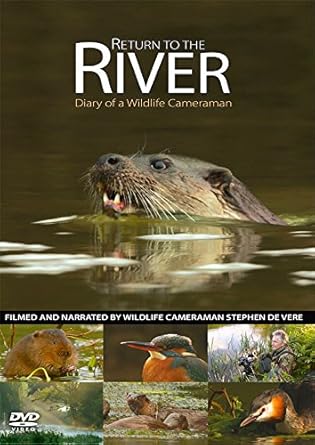
(c) Stephen De Vere
.
It might not have the cinematic scale of the recent BBC wildlife documentaries, but it does provide a more personal insight into our rivers and by returning to the same spot several times he documents the changes in the river and the behaviours of the animals - it seems he is revisiting old friends as he reveals their secret worlds.

Whilst the kingfisher and otter footage is sublime, it was not filmed in the area, it is another charismatic animal – the water vole -  that was filmed on the Ock.
Charting their behaviour, from their first emergence in spring and the establishment of their breeding territories, to seeking out new food sources and avoiding predators – by climbing trees and it is this seldom seen behaviour that has possibly never filmed before.
This was originally recorded in this blog (even if the camera work is somewhat shoddy and there is the everpresent incessant drone of the A34) and even inspired Stephen to seek out the water voles on the Ock (I even get a credit at the end of the film).
.

.
It is Stephen's determination, creativity and professionalism that has exceeded anything recorded in this blog and the way he has captured their behaviour which makes these shy, endearing and now unfortunately very rare creatures the stars of the film.

For anyone with an interest in river wildlife, this film is highly recommended and not just because a leading wildlife cameraman has chosen to film on our local river.

More information on this and Stephen’s other film ‘Through the Garden Gate’ can be found at: http://britishnaturefilms.com/films/

And Stephen is also on Twitter:  https://twitter.com/Stephen_deVere

Monday, 15 February 2016

River Levels

For some time the Environment Agency has been posting the river levels from their measuring stations on-line.  
But it can be some what difficult to navigate through its web site to find the desired river level (for example - the river Ock is found at https://flood-warning-information.service.gov.uk/station/7081).
The Environment Agency has now made this data publicly available and data mining and mapping company Shoothill (http://www.shoothill.com/) has taken it and produced an interactive map of live data of the  river levels in England & Wales:  http://www.gaugemap.co.uk/#!Map

Not only is this data available on their web site, but river level updates are available via twitter and can have widgets which can be embedded into web sites (such as the Ock widget, now in the panel on the right hand side).
The river levels can also be followed on Twitter and Facebook - which not only give the river levels, but any flood alerts too.

The widgets for three rivers in Abingdon are embedded below:

River Ock (Tesco Weir) 
Twitter: https://twitter.com/riverlevel_2453


Thames (Abingdon Lock):
Twitter: https://twitter.com/riverlevel_0962

River Stert:
Twitter: https://twitter.com/riverlevel_2452


Monday, 8 February 2016

Life and Death on a Sunday Afternoon.

For a blog about the River Ock, it has hardly featured as a subject since May last year.  So a gap in rain and gales on Sunday afternoon provided the opportunity for a walk along the river to see if anything had changed in the previous few months.
As it's winter, it's perhaps not surprising to see that the river is high, although it will take a lot more rain before it bursts it's banks.
.
.
As per normal for a dark cold day this there of year, there isn't much to see.  But along the side of the river, there are signs of an animal which is very seldom seen - fresh water muscles.
.
.
Maybe the muscles died a natural death and then were washed up the last time the river burst it's banks. Although muscles are a favourite food of otters, so maybe this is circumstantial evidence that they are still active on the Ock.
Perhaps the most likely explanation is they were washed up and an opportunist corvid took advantage of their unfortunate situation.
.
.
Another animal which met an unfortunate demise is this rabbit, quite what  set of circumstances caused it be squashed on a footpath will probably be never be known.
.
.
Yet it's not just signs of death along the river, a buttercup is starting to flower in the flood meadow, even though Meadow Buttercup doesn't normally flower till April.
Perhaps another symptom of our mixed up winter?
.

Thursday, 4 February 2016

Candlemas

Some  perennial plants such as daffodils, snowdrops and crocuses survive the hardships of winter by accumulating food in their bulbs and then when spring approaches, the warmer and lighter days result in the plant putting it's efforts into producing flowers.
With the traditional day of the first snowdrop flowers being Candlemas Day (2nd February).

But this year it has been different... 


.
Like a lot of places, the snowdrops in our garden have been in flower before Christmas.
Rather than flowering on Candlemas, quite of a few are loosing their flowers and once again returning to storing food in their bulbs:
.
.
It's not only the snowdrops aren't the only ones, the daffodils, which normally flower in March, have also started to flower prematurely.
.
.
And so have the crocuses, which usually flower towards the end of February.
.
.
The cause of this early flowering is the unseasonable warm weather the South of England has had in the past few months.
In 2013 the average UK temperature was  5.7 Celsius, in 2014 it was 4.4 and in 2015 it was 7.9 (reaching a maximum temperature of 16.6 in Sunderland) [1].

Whilst it is always good to see flowers on a winters day, it may have an adverse affect on on hibernating animals like insects, bats and hedgehogs.
Yet for animals which don't hibernate - like water voles, this may actually be good news as they won't have to seek food in harsh conditions.

Whether this mild winter is temporary or a more permanent change, time will tell.

Sources: 
[1] Met Office: www.metoffice.gov.uk/

Sunday, 31 January 2016

Return to the Blogosphere?

Last year the blog become mostly dormant, with the exception of the occasional post about visiting London, not much has happened on it since the summer.
Yet even when it was quite, the blog was experiencing the natural and un-natural world.

It applauded loudly as a professor of particle physics played keyboards with reformed electronic rock band New Order
.


It gasped in amazement at the sight of leopard in the African savannah.


.
It then felt saddened and disheartened that mankind's inhumanity, greed and outdated beliefs has meant that it is almost impossible to see a rhinoceros in the wild:
.
.
It got wet and cold looking for signs of dinosaurs on the Isle of Wight.


It was frustrated at just glimpsing a Purple Emperor butterfly.


And it enjoyed experiencing the bleakness of the Cambridgeshire Fens in Autumn.


So maybe it's time for the blog to wake up from it's hibernation, hope the muse returns and to see if it still has any friends out there.

Maybe some of 2015's activities will feature in future posts, but if not 2016 has plenty of opportunities:

  • To see how the water voles have coped with the mild winter.
  • To investigate if otters are still present on the Ock.
  • To further explore the Radley Lakes area of Abingdon
  • To venture into other parts of Abingdon and Oxfordshire countryside
  • To try and get better views of the illusive purple emperor.
  • To further explore downstream of the Ock and it's tributaries.
  • To enjoy other Natural History Museums in this country.

Having had a rest, perhaps 2016 will be a good year for the blog?  
And if anyone is still reading, it would be pleased to hear from them, especially if they have any suggestions for subjects of posts or places to visit.

Tuesday, 15 September 2015

Life Story

Back in May, I received a very thoughtful birthday present - a pair of tickets to a concert at the Proms.
So three months later we went down to the Royal Albert Hall. 


I'm not a particular fan of classic music, but this was a rather special concert, the music from the BBC wildlife series Life Story, played by the BBC concert orchestra and presented by Sir David Attenborough.

Prior to the concert we attended a BBC Proms Extra - a 45 minute discussion at the nearby Royal College of Music - with the composer Murray Gold (best know for his work on Doctor Who) and series producer Michael Gunton.
.

.
Who discussed the problems of producing a program that was constructed from 2000 hours of film footage and composing a complex score from very rough edits.

One hour later was the proms itself, whilst the orchestra received a warm applause the greeting which Sir David received was almost rapturous.
.
.
The concert took the form of Sir David introducing (basically the Life Story narration) the corresponding clips which were projected onto several large screens around the hall, whilst the orchestra played the corresponding score.
.
.
I have never been a particular fan of music in natural history programmes - preferring the sounds of the natural world or finding it a distraction from the narration.
Yet in this instance I have become to appreciate how important it can be to help the narrative, especially when the scene itself features very little natural sound.

For example, the use of exotic percussion to enhance the situation comedy that is hermit crabs forming their own housing chain.


Or using a violin and accordion to construct a tango to reflect the final fatal dance of a male Peacock Spider.


The subtle use of the string section (and clever editing) to reflect the emotion and pathos of a herd of elephants examining the remains of a long dead relative:


And constructing a dramatic sense of tension as young praying mantis start to make their way in the world - which matches anything out of Hollywood (or in the case of Alien, Pinewood) and a twist at the end which surpasses most films:


Certainly the music adds a huge amount to each scene and considerably enhances the dramatic effect, it also reflects emotions that may or may not exist in the natural world - comedy, fear, grief and suspense - but without it, the series would be significantly less impressive.

And for me, not only seeing a true icon, but to hear such excellent music played by some of the finest musicians has been one of the highlights of the year.

At the time of writing, the concert is still available on BBC iPlayer and is well worth listening to.

http://www.bbc.co.uk/events/edxwhn#b0684vct

As is the BBC Proms Extra:

http://www.bbc.co.uk/events/ezfgwh#b0680hp8

All films are copyright BBC.

Saturday, 13 June 2015

Grant Museum of Zoology

Most visitors to London, who are interested in the natural world, flock to the Natural History  Museum, yet on the corner of Gower Street and University Street is the Grant Museum of Zoology, the last university zoological museum in London
.
.
It doesn't have a plaster cast of a Pennsylvanian diplodocus or a near complete stegosaurs, and is considerably smaller than it's more famous counterpart on Cromwell Road.
But it does have many interesting and fascinating items on display, including a hippo skull:


.
A fascinating boa constrictor skeleton:
.
.
A cast of an archaeopteryx fossil:
.
.
And a skeleton of a Thylacines (Tasmanian Tiger), which become extinct in 1936:
.

.
Although some of the displays are just bizarre, including a jar of pickled moles:
.
.
Yet the most interesting and fascinating thing is the Micraium, a collection of over 2000 of the universities slides, backlit by light boxes:
.
.
.

.
 .
A fascinating and clever feature which hopefully other Natural History Museums might emulate.